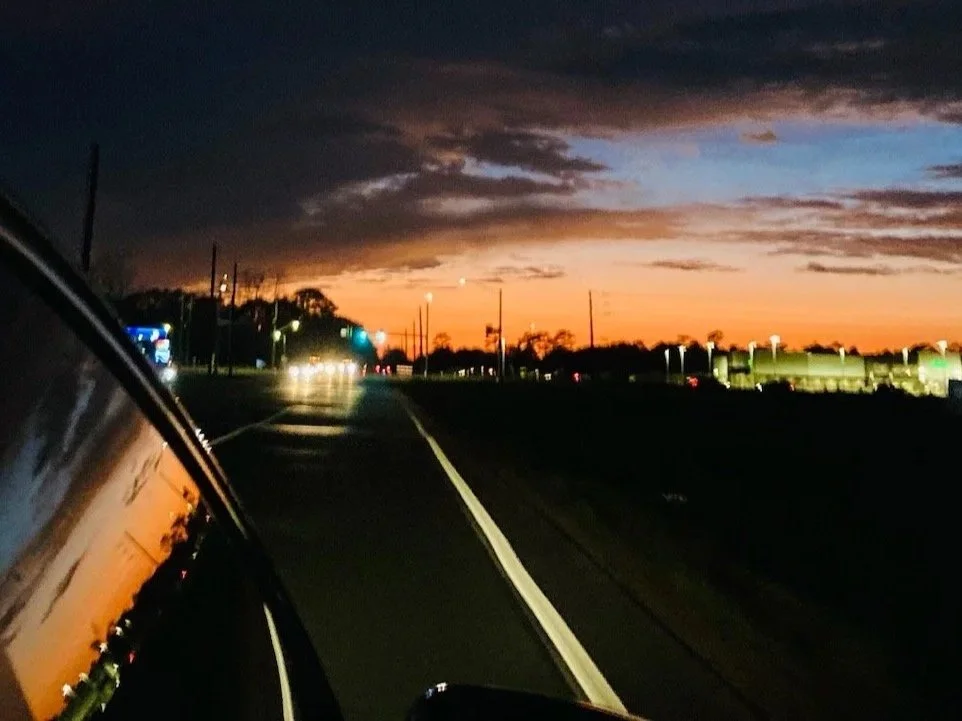
The Father’s Affection
I wrote this post originally on another blog that our family kept about our adventures and misadventures in being missionaries and world travelers. I published this in January of 2020, just before the pandemic tsunami hit our part of the world. Deep down, for reasons unrelated to the pandemic, my inner world was already crumbling and I didn’t know it yet. Only three weeks prior to it, I’d finished my first painting in over twenty years. I also didn’t foresee the renaissance my soul was about to experience.
After reading this article, I realized that I didn’t clearly identify a single word that became more vivid to me through the experience of lying next to my youngest son while he slept. When I think of those moments, “affection” is the word that sums them up, both as a feeling and expression.
23 January 2020
Some people learn languages through brute force or clever pneumonic devices. But for me, for most of the Spanish words that have stuck with me, there is an experience or a mental picture attached. For example, I learned the word corazon (heart) when I went on my first teaching trip to Peru with Reaching & Teaching in 2014, before I spoke any Spanish. The teacher, Felipe, repeated this word, gesturing passionately. Concluding that this was an important word for the lesson, I asked the interpreter what it meant. Of the many vocabulary words that have coursed through my brain through the years, that one got stuck.
Similarly, when I hear the word ahorita, it makes me think of Oaxaca, Mexico. Although it means “in a little while,” that can mean twenty minutes or two days. A group of pastors told us they were coming to the training, but that they would be there ahorita. They never showed up, which only enhances the running joke. So, others who shared the experience can say, when we’re asked how long something will take, “Ahorita.” Or, when I think of ceniza (ash), I think specifically of the daily task of sweeping black dust from our floor in Costa Rica.
Words as abstractions tend to pass in and out of our minds, but words connected to pictures and experiences get lodged in our hearts and remain there.
While we were in Costa Rica, our youngest son, Lucas, who was then four years old, really struggled with the change to all-day school, which was half in Spanish and half in English. He began hitting himself in the face, he cried and screamed frequently, and always seemed distant and angry. Since he really wasn’t required by any law to stay in school the entire day, Sarah and I decided to start taking him home with us once our classes were done at midday.
His little legs moved as slow as molasses on those long walks home. But I could always speed them up when I offered to stop by the abastecedor (“supplier”, corner store) to buy Pingüinos (literally “penguins,” but little cream-filled chocolate cupcakes). Once we got home, I put him in his bed for a siesta. I prayed for him, but then I laid there next to him until he fell asleep. Not infrequently, I fell asleep for a few minutes as well.
Nowadays, being the youngest, he goes to bed before his siblings, and I’m usually the one to put him to bed. He asks, almost every night, for me to lie beside him for a few minutes. Those few minutes lying in the bed with my little boy are some of the most profound minutes I have in the day. I observe that Lucas isn’t fretful about anything, or antsy to be somewhere else. If he knows I’m sticking around, he remains still and goes right to sleep. I myself am calmed by his calmness. In his little-boy heart he knows his dad is looking out for him, just being with him. And every night, the experience draws me to the joy of my Father in heaven. The truth of Scripture sticks in my heart, even more than Spanish vocabulary, as I meditate on what it reveals about our God:
He will not let your foot be moved; he who keeps you will not slumber. Behold, he who keeps Israel will neither slumber nor sleep. The LORD is your keeper… Psalm 121:3-5
The LORD your God who goes before you will himself fight for you, just as he did for you in Egypt before your eyes, and in the wilderness, where you have seen how the LORD your God carried you, as a man carries his son, all the way that you went until you came to this place.’ Deuteronomy 1:30-31
“Can a woman forget her nursing child, that she should have no compassion on the son of her womb? Even these may forget, yet I will not forget you. Behold, I have engraved you on the palms of my hands…” Isaiah 49:15-16
See what kind of love the Father has given to us, that we should be called children of God; and so we are. The reason why the world does not know us is that it did not know him. Beloved, we are God’s children now, and what we will be has not yet appeared; but we know that when he appears we will be like him, because we shall see him as he is. 1 John 3:1-2
If you then, who are evil, know how to give good gifts to your children, how much more will the heavenly Father give the Holy Spirit (that is, His living, abiding presence in the Person of the Spirit) to those who ask him!” Luke 11:13
Indeed, how great is the Father’s love. As I go throughout the day, I am trying more than ever to hang onto the truth about Him and His affection for His children, which is lavished on us in the Beloved Jesus. Applying the Word of God to our moment-by-moment experiences and meditations is how the Word gets lodged more deeply in our hearts and stays there over the long haul. So then, when the dark night comes, we already know He is sticking around, He doesn’t sleep, He will carry us as a man carries His son, and He will see us all the way through to the eternal dawn.
A Year without (Much) Color
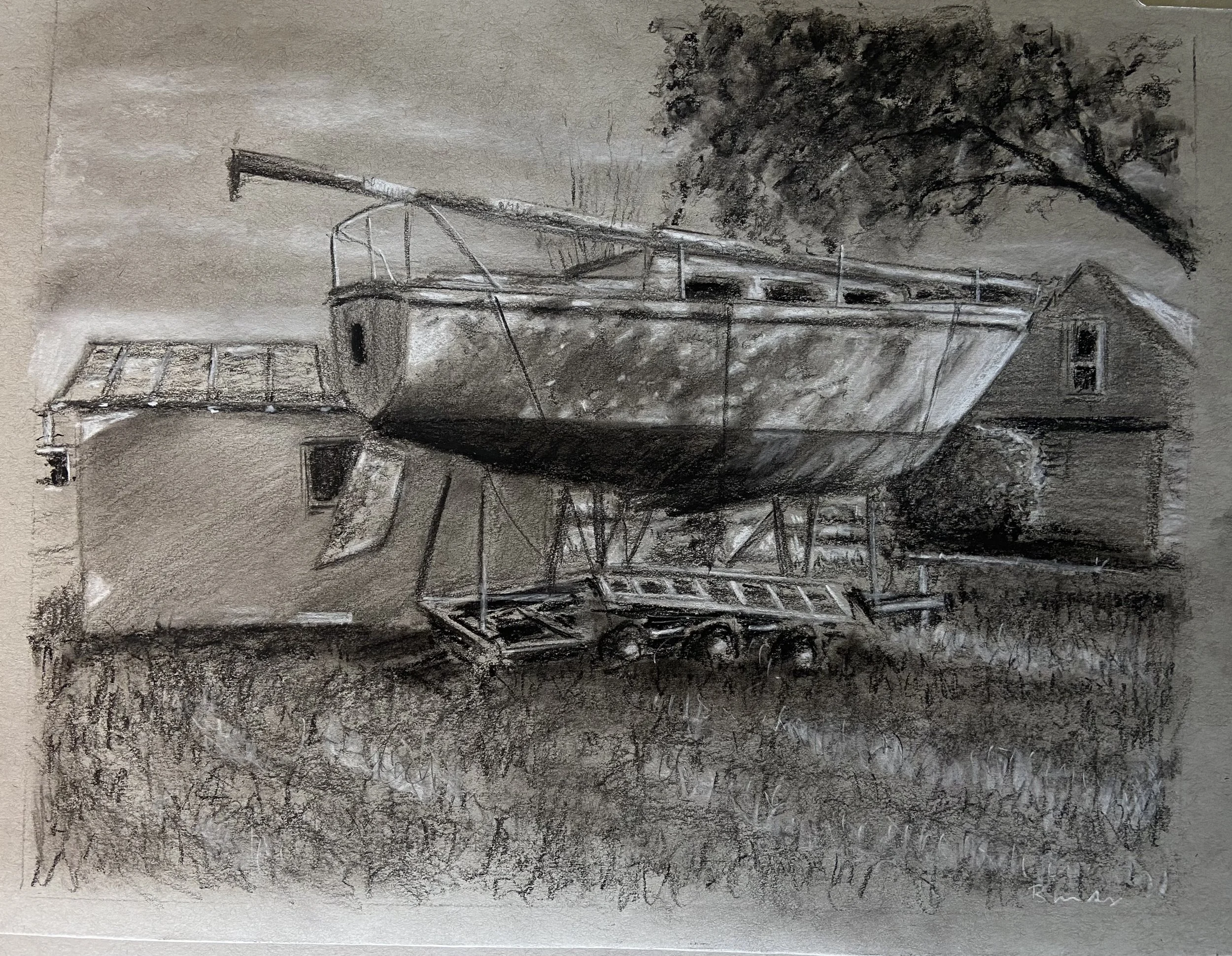
Some insights I’ve gained by choosing to work in charcoal this year…
It's been an interesting year, art-wise. After finishing the big US Army Corps of Engineers commission last year, we broke down my home studio and moved my supplies out of the bedroom. Currently all my painting supplies are stored at the church where I work as one of its pastors.
It's not an ideal setup. The borrowed easel sits backstage, where there's no natural light and very little help from lamps. I've managed to punch out a handful of paintings this year, but it was not without difficulty. Working from a home studio in your bedroom presents a host of other challenges, so I don't prefer that option. I continue to pray. Who knows if there isn't a studio space somewhere that will appear in the middle of Silverhill, like the Room of Requirement at Hogwarts?
In the meantime, I've been focusing on charcoal, which has been a deep learning experience. So... what have a I learned?
Charcoal is messy. Like, way messier than I'd ever anticipated. I wore through a Magic Eraser after I spilled compressed charcoal powder on the floor of our bathroom. Also, it makes my hands look like I've been pulling a shift at Express Oil Change. Thankfully, it washes off. Mostly.
Charcoal is dramatic. One reason I like nocturne paintings so much is that it gives a high degree of value contrast. The dark makes the light sources pop. I did a simple drawing of the street light outside our house. The soft way the light draws the eye to the reflection on the wet street made me think of our whole generation that were told to come home when the street lights came on. The intense darks and lights communicate a lot of emotion, and I love that about the interplay between dark compressed charcoal and white soft pastel.
Charcoal is forgiving. My process normally starts with throwing willow dust onto the paper, and then I blend it all into abstract shapes with a stump. Next, I make a loose willow sketch and start to erase the highlight areas. Early on, I noticed how easily charcoal, especially willow, comes off the page with a simple kneaded eraser. Somehow, knowing that the medium will forgive you takes away your fear of screwing up; and when that fear is gone, you don't screw up as much. There's a sermon in that.
Charcoal is cheap. My friend Steve, who turned me on to charcoal, is a master of this medium. He makes his own willow charcoal sticks on his grill in a little "oven" made from two tin cans. I'm not there yet, but I love that it costs barely five bucks to get a box of charcoal sticks.
Charcoal helps you to simplify your composition. The more gestural I can be, the better. I am not a surgically precise kind of artist. I don't like tedium. I want to move my hands, my arms. I want to throw stuff around on the surface. I want to work everywhere all at once. Charcoal allows me to work with my hand directly to paper, very quickly, and I can see right away whether the composition is interesting before having to commit. Besides, remember the eraser thing...?
Charcoal offers a lot of expressive freedom. Similar to the previous point, charcoal helps me to make lots of movements and strokes. It helps me not to be enslaved to the reference photo or subject. I don't obsess about how straight my lines are (sighing, looking like the Ben Affleck smoking picture...). Sometimes I do go for a more realistic rendering, but I also just want to be able to scratch up the paper and create a dramatic suggestion of a story. One of my goals as an artist is to be more free to create a work of art, and less conscious of how much it looks like a “picture.” I don't believe we were created for "absolute freedom." That's nonsense. I believe true freedom comes with limits. Limitless freedom is anarchy, which ends up in a form of slavery. But charcoal helps me to be more free from the opinions of others, from the inner critic who doesn't like my work and doesn't think it looks realistic enough.
I truly hope to get back into oil painting in the coming years, but for now, God in his Providence has guided me into a medium that is enabling me to learn some important lessons both about myself and my art.
You can see all these pieces I've been developing over the past year in this medium at an exhibit at the University of South Alabama. The exhibit will run through July and August at the Rodning Gallery in Marx Library.
A Tribute to Gallerists (and a Concern about Utilitarian Art Culture)
Art exists, not as superfluous to our existence, but as evidence that something about our existence is worth celebrating.
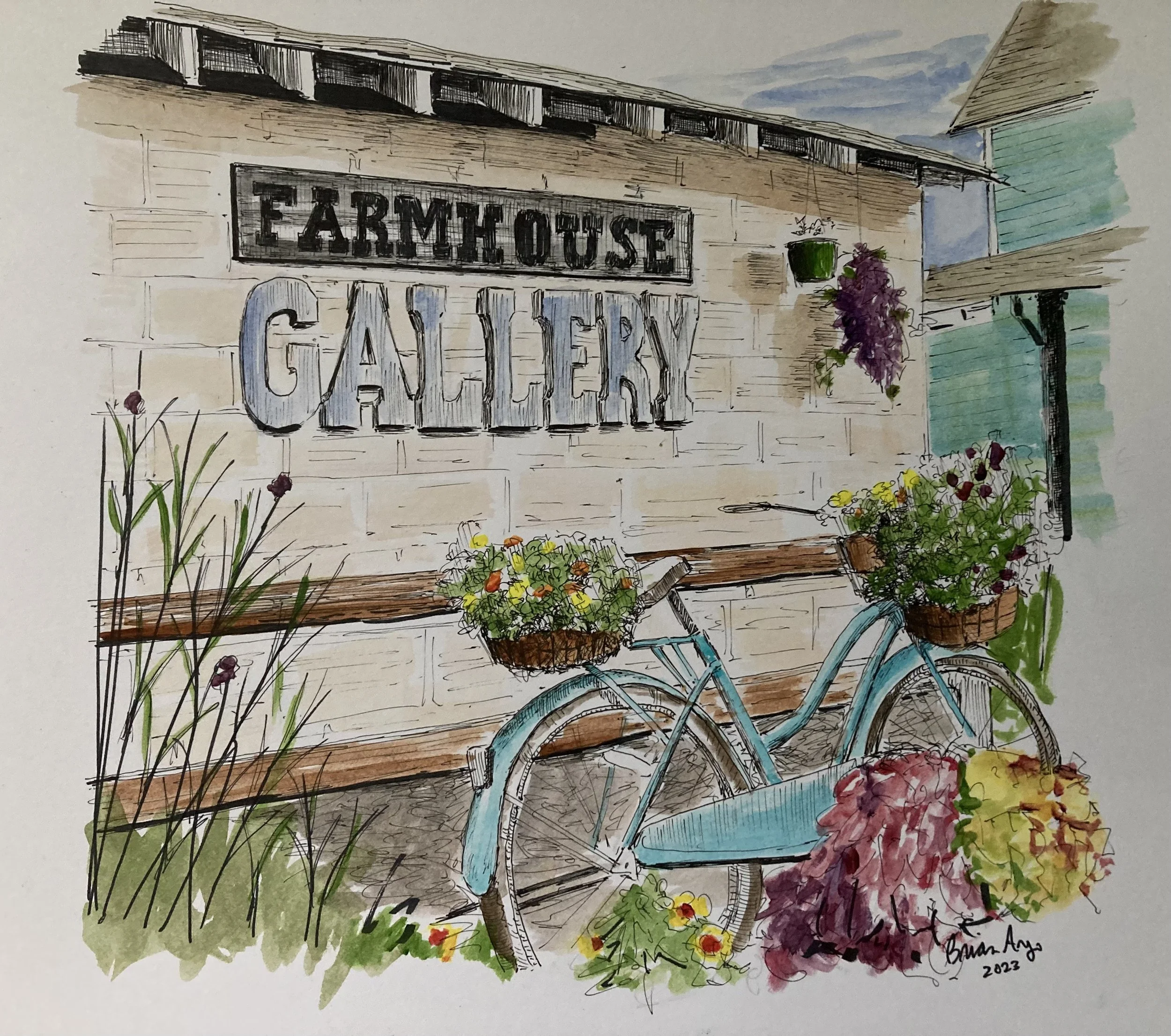
About five years ago a gallery opened in our tiny town of Silverhill, Alabama. Marine photographer Lynn Jordan opened a beautiful gallery about a quarter of a mile from our home. One day I stopped by to introduce myself, and by the end of that conversation Lynn had welcomed me to show work in her gallery. The Farmhouse Gallery was my first time "officially" showing work somewhere, and I was so honored and thankful to get to be a part of that gallery while it was open. It felt like the roots of my soul went miles down into the earth and community of which I was now a part.
Today I picked up my artwork from a gallerist's home. My work, and that of many other artists, had been part of an endeavor that did not work out for a hundred reasons beyond the gallerist's control. She had invested so much time and money, only to have it not come to fruition. It was a sad conversation, though not without hope.
As an artist, of course I have a deep appreciation for the arts, for artists, and for artisans. But today I have a much deeper appreciation for those who venture to open galleries. There are those who sink thousands upon thousands of dollars to create delightful spaces to show unforeseen beauty to the world. They invest countless hours thinking, creating, collaborating, moving backbreaking furniture, bringing old buildings up to code... and for what? To give space to fill the world with more beauty.
We talked briefly about what a difficult few years it has been for artists. For example, AI remains a threat for working artists. But on top of that, people are holding their money from purchasing a seeming "luxury" like a painting. However, art is not a luxury; but it is not exactly a "necessity" in the way that food, water, and shelter are. It's an "essential" in the way that friendship is. Physically, can you survive with only food, water, and shelter, with no companions? Yes. But does anyone really see that as an ideal way to live? It's same with art.
Art exists, not as superfluous to our existence, but as evidence that something about our existence is worth celebrating.
The kind of gallerists that I'm talking about here are those that understand the essentiality of art, and they sacrifice so much for it. Pause with me for a moment and give thanks for such people....
Now, one brief thought. Artists are struggling now, not because there's no money to pay for their work or services. Universities pay an obscene amount of money for coaches and, now, players. People spend loads of money on sports or hobbies (myself included, having a family of four athletes). All around me I see people spending money. Money isn't the issue. Most local cultures are utilitarian about art. College football is a great example.
So much artful creativity goes into a single football game. The announcers say the same empty nonsense again and again. They repeat empty rhetoric and hip-shot opinions in hopes that no one is even listening, so that no one has to take the time to point how often they contradict themselves and say ridiculous things. Still, an artist advised on their clothing (as silly as some of them seem to dress). Every promo involves digital creativity, music, design, etc. People spend millions on this, and for what? So that we'll watch football and continue idolizing 19-and-20-year-old young men.
I have complained about living in a culture that fails to appreciate art. But it's deeper than that. Most of us live in a culture that appreciates only utilitarian art. Art is good only insofar as it's useful for facilitating interest in something that makes money. Billboards. Commercials. Logos. Brands. Sporting events. Utilitarian art does not magnify the beauty of God's creation. Rather, it exalts man's achievement and exploits man's vulnerabilities for profit.
Art--true art--sends beauty into the world for the purpose of promoting human flourishing and reflecting the glory of our Creator. Some artists do this, despite not even believing in God's existence.
I hope and I pray for cultural change. Yes, artists need to sell artwork. But, as Jeff Goins says, "We don't make art to make money; we need to make money so we can make more art." But what really has to happen is that a person needs a glimpse of heavenly glory. A good painting does this. A national championship for your team, amazing as that is, only reflects a man-centered glory that lives and dies with us here on earth. Good art, the art of Rembrandt, for example, points us toward a glory that will fill all of eternity, awakens that heavenly longing in our hearts, and prepares us to enjoy it forever. A lasting glory, not the fading glory of man's earthly achievement.
I'll say it once more: Art exists, not as superfluous to our existence, but as evidence that something about our existence is worth celebrating.
On the Death (and Resurrection) of Dreams
Dreams sometimes have to die, so they can be raised as something better and incomprehensibly glorious.
Lazarus died. Several days later, Jesus raised him. What we don’t often think about is that Lazarus had to die again.
From the time I was very little, I've seen myself as an artist. When I was in kindergarten, my brother's friend showed us a drawing he'd done of my dad's childhood home. It was that drawing that made me want to become an artist.
The next year, my first grade teacher posted my drawing of my brother's three-wheeler in the elementary school art show. After that year, I had at least one entry per year in our school's art show. In high school, I had a piece in our county-wide art show at Botanical Gardens in Birmingham. My senior year of high school, I got an honorable mention at the Birmingham-Southern College art show.
By the time I finished high school, I felt I was well on my way to pursuing art of some kind. I was planning to major in religion at the University of Mobile, with a minor in art. What I was planning to do as a career, I had no idea. (I'd also toyed around with the idea of pursuing a music degree in Nashville...). People said there was no money in fine art. It was alright for a hobby, but not as a career. It would be better to have a primary job, such as graphic design or engineering. Neither of those was an option for me: I hated mathematical precision and I wasn't interested in designing logos.
I took my first drawing course in college. I'd always believed myself a decent draftsman, but the weekly critiques exposed weaknesses in my drawing and compositions. But the critiques usually weren't about technical issues with my drawing, such as proportion or value. The main objection my professor and fellow students had about my work was that it wasn't interesting. I tried too hard to replicate what I saw. Looking back, it was more probably my injured pride that was to blame for dropping the art minor, and art, altogether.
I poured myself into studying theology and the Bible. As a growing Christian, I found that I loved to study the Bible. I loved it so much I felt called to teach it, which led me to twenty years of some form of church ministry. During that time, the only art I did was an occasional drawing for my family. Though precious to them, they weren’t very good.
Pastoral ministry required so much that I tried to kill off the nagging creative at the back of my soul. I wasn’t an artist anymore, I told myself. I was a pastor, theologian, missionary, even a musician—not an artist.
Then, in the span of a few years, I found myself as none of those things I’d tried so hard to be. I was no longer a pastor, and I didn't even want to touch a book of theology. Sarah and I watched a dream of being missionaries die, which was some of the worst pain we’d ever felt.
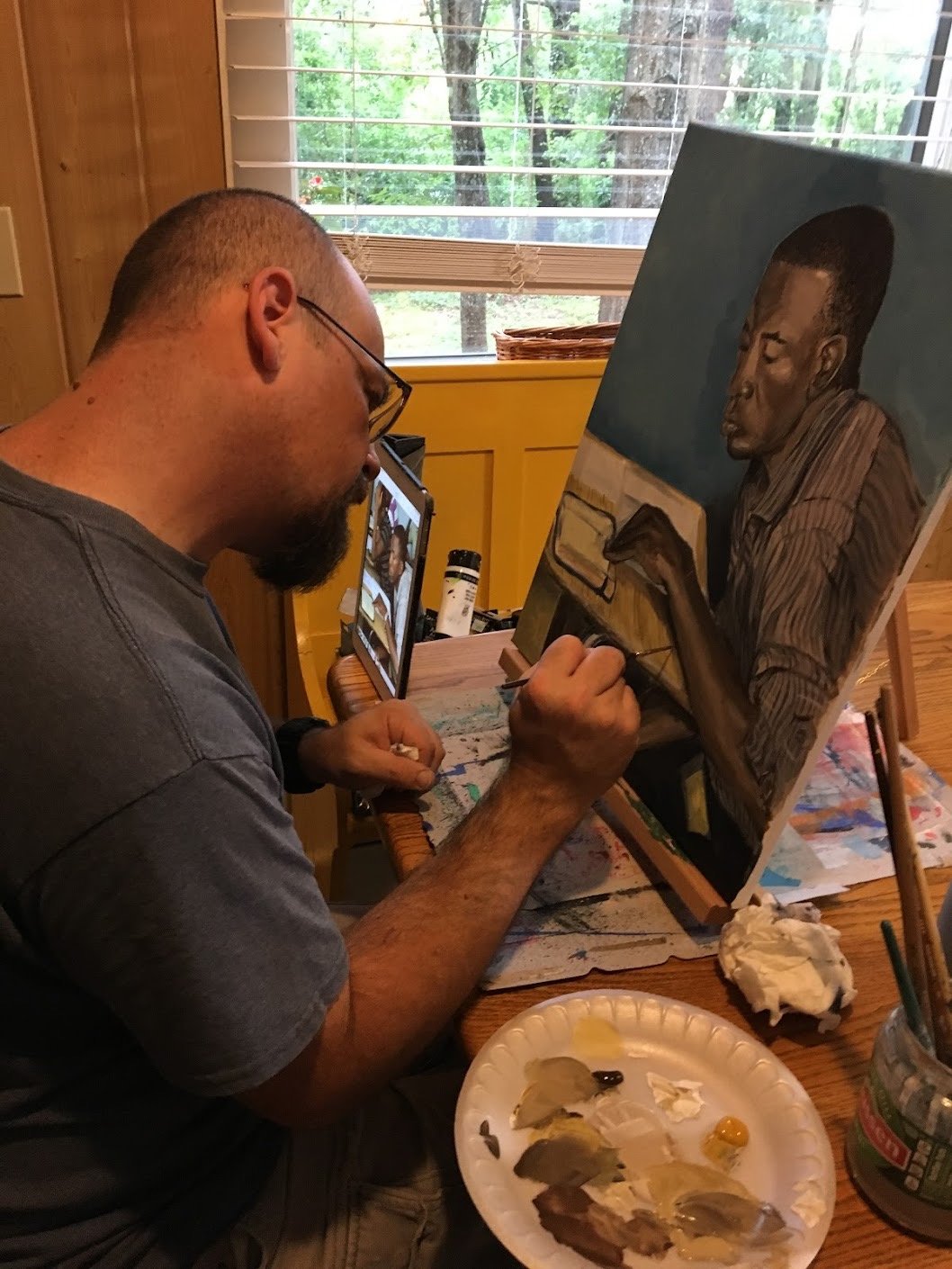
2019 came and I was going through anxiety as I’d never experienced it. I needed something to occupy my restless mind, something good for my soul. At some point that year, before the anxiety really hit, I'd spent nearly all the birthday money I’d been given and bought supplies for drawing. I started by sketching trees near our home. I began dreaming of paintings. My soul did what I imagine a wilted flower does when it gets watered for the first time in a while.
After I started to draw, I then started to paint. Then I started to sell. Commissions followed. Sarah and I rented a booth in an antique mall and sold a few pieces. Shops asked to sell my work. A couple of galleries kindly showed my work. I was invited to participate in festivals. I was on the news showing a mural I’d done in downtown Silverhill. Silverhill’s mayor commissioned and purchased several pieces. With the US Army Corps of Engineers commission this year, the biggest I’ve ever had, everything seemed geared into the direction of an art career, as I’d dreamed since I was a boy.
Then…I had to stop. Art had become my escape when I had neglected much in my life: my marriage, time for rest, my family, my home, my soul. It’s no small irony that an instrument of God’s grace can easily become a substitute for Him.
I have many questions to answer about my vocations as an artist and minister. Art has been a dearly loved thing, but I don’t want it to become an ultimate thing. I’m convinced (mostly) that sales and commissions have dried up because God wants something better for me and the people closest to me. Dreams sometimes have to die, so they can be raised as something better and incomprehensibly glorious.
Like Lazarus after his second resurrection.
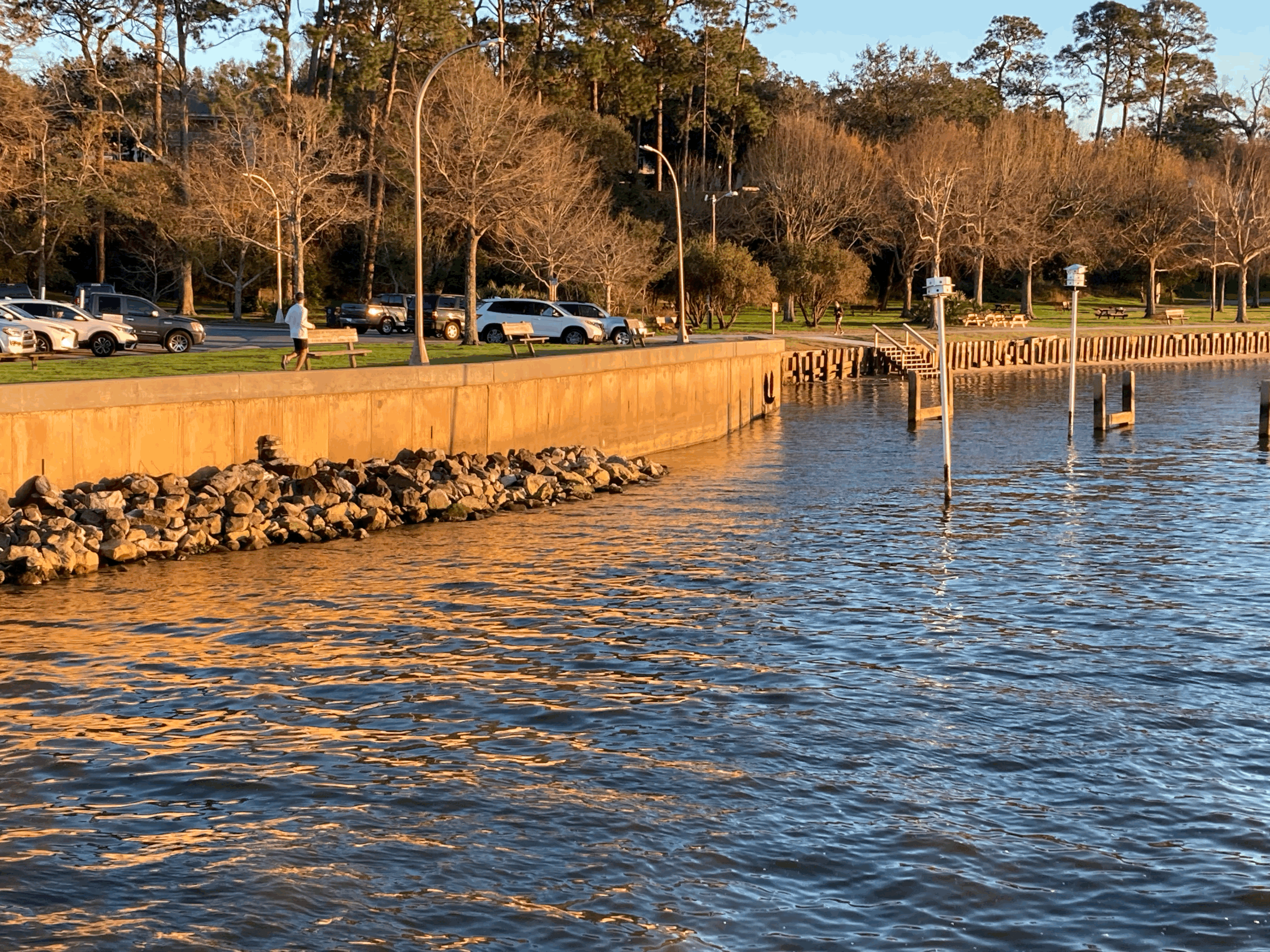
Patience: The Painter’s Cardinal Virtue
The thing that sets an artist apart is patience. The defining characteristic of the great master painters in the days to come, where AI threatens the very core of artistic being, is patience. Patience in painting covers a multitude of artistic sins.
In the age of social media, most artists know that, if an artist wants to succeed, one thing he or she must do, supposedly, is to create lots of Instagram reels. In order to get as many views as possible, the reels need to be short and simple, even ridiculous. For a long while, the trend was the artist waving their brush at an empty canvas and, pop, the work was done. Although we know (I hope) that the work wasn't produced in an instant, we still have no idea how long it took the artist to finish. Whether we realize it or not, artists have been shaped over the past century by a misapprehension regarding time.
The Joy of Painting is arguably the most popular painting show of all time. Bob Ross would finish a painting within a half hour using his oft misunderstood method (it's way harder than it looks, folks). People doing paint-alongs were often frustrated that it took them so long to paint what looked fairly simple for Bob. What no one tells you is that Bob Ross frequently painted other versions of the painting that ended up getting aired live. He always knew where he was going with that paint brush before he "beat the devil out of it." Plus, Brother Bob had been painting those scenes for many years.
Two of my favorite painting shows also feature artists who finish a piece within less than half an hour of what seems like a seamless, wet on wet first try.
I understand why painting shows, cooking shows, or home repair shows, compress the process to make it fit 30-60 minutes. It's good for entertainment and it guarantees a spot on television because it's not boring.
So, what does the obsession with producing frequently and making the process look fairly easy say about us? We are not, as a whole, very patient people.
Yes, I realize that modern conveniences and technology make producing artwork way easier than it used to be. But consider what it used to take to produce a masterpiece:
Da Vinci took 3-4 years to complete the Mona Lisa, which is only 30" x 21"
Van Gogh, though he often painted frantically and quickly, took over a year to finish the Starry Night.
Picasso could also work very quickly, but he still spent two years on one of his most famous works, Guernica.
Monet spent years working on Water Lilies.
Aside from da Vinci, these are more recent examples. I know that artists out there are taking a lot of time to finish masterpieces, and I'm thankful for artists who are straightforward about how much patience is required. In fact, I believe that the number one quality that makes an artist a master is not the ability to work quickly, but the ability to work slowly with laser focus over a long period of time. (Let me be clear: I am not there... yet.)
My favorite art show at the moment is Portrait Artist of the Year. For each heat of the competition, the artists only have four hours to complete a portrait of someone they've never painted before. However, with each artist's submission, the narrator explains how much time the works they submitted to get into the competition took. There has seldom been a master-quality work on this show that didn't take well beyond the 4 hour allotment. Many artists on the show produce remarkable pieces in a four hour period, but I'm thankful for the wisdom that takes into account what the artist can do when there isn't a time crunch.
As an artist, two of the most beautiful words a patron can tell you is: No rush. A patron who says that is someone who understands that quality requires patience. Otherwise, it's just a mass-produced artifact that does not really connect all that well to a person's soul. You can get that from Hobby Lobby. (Please don't, by the way.)
So, what's the point of this? Well, I think there are just two things I would suggest to artists, like me, who struggle with patience.
Tell people how long it really takes to do what you do, even in your reels. It can encourage other artists to keep pressing on, to be realistic about time, and could help combat the tendency in us to show off. We're not competing with AI (which lacks soul and therefore cannot reach the soul) nor should we be trying to show up other artists. Watching Mark Boedges work has been a rewarding experience. First of all, he is one of the best landscape painters in our country. And I believe he's that way because he is deliberate and patient. Knowing how he paces himself helps me to pace myself because, if I could paint half as well as him, I'd consider it a great accomplishment.
Take longer. Like I said, patience in painting covers a multitude of artistic "sins" like compositional weakness, lack of tonal variety, mud-mixing colors, etc. When you take your time, you can focus on things like compositional simplicity, color harmony, drawing, listening to guidance, etc. A good friend who was a professional house painter once told me, "The main difference between a good painter and a great painter is someone who goes back to check his drips." How many times have you had to sand down some hasty painter’s dried drips in your house in order to paint over it?
When it comes to this cardinal virtue, I myself am a plain old sinner. But, since I believe in the power of art to capture the true, the good, and the beautiful, it's worth all my best efforts to believe that my best work requires that I not hurry.
S. D. Smith’s The Green Ember and the Role of Artists in Community
…the Green Ember series by S. D. Smith. It's an epic tale about anthropomorphized rabbits, wolves, and birds of prey. One thing that is unique about the tale is the running theme of the "Mended Wood."
Blaise Pascal, in his Pensées, writes, "How useless is painting, which attracts admiration by the resemblance of things, the originals of which we do not admire."
At first glance, I took offense at this. Pascal probably would have adjusted his view if he'd lived long enough, but alas, he died a relatively young man (39). After some thought, I realized that he's only half right. True, painting that is mere replication of reality is useless. Painting that does not lead to deeper appreciation for creation is mere vanity and an appeal for praise. However, Pascal never lived to see the potential painting has for God's redemptive purposes in the world.
Yesterday I was listening to a podcast my wife had recommended. On Grace at the Fray, Hunter Dockery was talking about what a city needs when missionaries are sent to it. One of the things he mentioned was that a city needs beauty. He goes on, "What artists do is actually reach into the future, actually reach into heaven... and they're bringing back pictures from there. And it's beautiful. And they're saying, 'This is where we're headed.'"
And that brings me to the Green Ember series by S. D. Smith. It's an epic tale about anthropomorphized rabbits, wolves, and birds of prey. One thing that is unique about the tale is the running theme of the "Mended Wood."
Two of the main characters, Heather and Picket, are chased by wolves to a refuge called Cloud Mountain, a fortified and hidden commune of rabbits. After the attack, which included the death of a friend and member of their community, several of the leading rabbits of Cloud Mountain get reports on what's been happening in the outside world. Once the catastrophic news has been reported, Lord Rake says, "It will not be so in the Mended Wood." And the group gathered there responds, defiantly, "The Mended Wood!"
At the mention of the Mended Wood, every face is changed. Everyone now finds himself or herself with courage and hope, simply by the mention of this "Mended Wood." As you read the story, the inhabitants of Cloud Mountain refer to themselves as "heralds of the Mended Wood." When Heather asks Emma what this means, Emma simply shows Heather. The series unveils a picture of a world coming apart, yet with colonies of "heralds" who believe in a world where everything broken will be mended. All will be at peace, restored, good. It's the Old Testament picture of Shalom: total well bring, everything that was ruined made new. What Emma shows Heather is simply each rabbit plying his or her own trade, doing it beautifully and excellently, for the good of all the others.
I believe, in some sense, that the artist's duty is to be a herald of the Mended Wood, someone who reaches into the future and brings back a picture of what is waiting for those who believe, so that we might gain hope and courage in a broken world of rockets, corruption, betrayal, selfishness, greed, hatred, and idolatry.
If I believed painting was useless, I wouldn't do it. But I still hold that we as artists have an opportunity to do more than depict what we see. We can try to do so in such a way as to signal a world to come, a world healed by the coming Christ. New heavens and new earth, with the glory of the Lord as our light. Whether we can name it or not, or are willing to acknowledge it or not, this is the longing stirred in every single human being when we see something beautiful.
Brevity: Thinking about Azaleas, Camellias, and Japanese Magnolias
It seems that the best things we experience in life are often the most short-lived. People wait in line for hours for a roller coaster that lasts a couple of minutes. People wait for years on a book only to devour it in a couple of days (that was me with every Harry Potter book after The Goblet of Fire). There are some things that through self-discipline we can learn to savor. On the other hand, there are things of which only the most fleeting form of enjoyment is possible.
The most beautiful blooms I know of are transitory.
Winter in South Alabama is itself fairly brief, but dreary nonetheless. A lot of artists prefer winter over summer because a plethora of greens can feel boring. Winter, though it looks depressing, affords the artist many options for color and composition, especially where I live. When I look out my window right now, I see mostly leafless trees and yellowed grass. The tree line has a backdrop of dark pines obscured by legions of skeletal branches. It's a depressed artist's wonderland.
Standing out from the gloom are the azaleas, the camellias, and the Japanese magnolias. The first one I noticed in the microcosm of my yard was the camellia. We have one near the street with blood-red blooms. They signal spring like the Robins and the honking Geese. The camellias burst out of the dark green like bright red taillights. I savor them almost every time I walk out my door, and I lament when they begin to wither. Such is life.
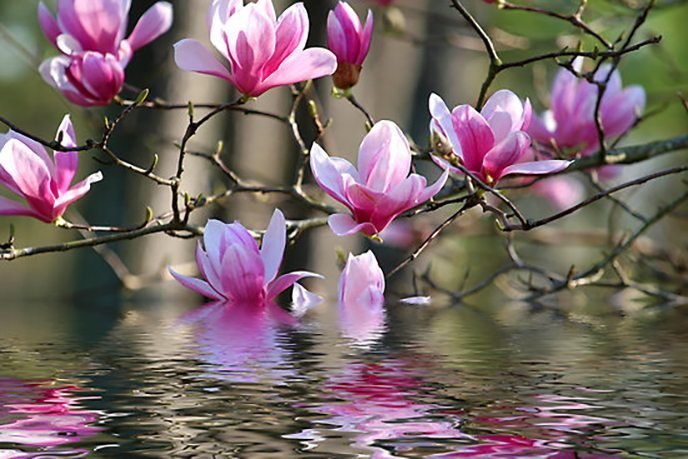
Next I noticed the Japanese magnolias. Different than our Southern magnolias, these blooms explode from twiggy branches that look unable to support such life and beauty. Rich magenta or lavender moving upward to a softer rose color. And for weeks those extravagant cups sit proudly on so many lawns in our area. Soon, they'll be gone. Such is life.
Right now, the azaleas are starting to make their way into the spotlight. For those who don't know, azaleas bloom twice a year (as do camellias, come to that). Our yard has a set of azalea bushes about sixty years old. They're a mess and we're in the process of cleaning them up so they can flourish (and so our neighbors can stop judging us). Even still, those bright purply pink blooms will find their way to shout for attention out of the tangled mess of brambles and intrusive volunteer plants. But soon and very soon, they'll be gone. Such is life.
Why do the most beautiful images in creation only last a while? I wonder sometimes if art is just another way of trying to preserve fleeting moments in time. Sunsets are the most elusive subjects to paint, yet they're one of the most popular subjects among representational landscape painters. There's a reason landscape painters refer to nature as a "drunk model": she won't sit still.
It's a morbid fact, perhaps, but every human being will reach his or her own sunset. Our blooms all wither. Art can help us savor the transient for a little longer, but art cannot prevent the seasons from changing.
I don't paint under any illusion that life as we know it can continue forever. However, I work with the hope that all creation will be renewed. And everyone, through faith in Christ, will be reborn and raised imperishable. Until that day, I will savor the beautiful sight of the Japanese magnolia, the azalea, and the camellia. And I will be sad when they're gone.
Until they come again.
Art & Story
One thing that is very important to me as an artist is “story.” I want to create art that tells a story in some way. This does not always involve figures, though it sometimes does. Even in a landscape with an empty field, one has to remember that we wouldn’t have the scene without the “seer,” the one responsible for seeing and rendering the landscape. We ask questions like, “Why is this setting so important to the artist? What is there to see? Why should I value it the same way he or she does?”
One thing that is very important to me as an artist is “story.” I want to create art that tells a story in some way. This does not always involve figures, though it sometimes does. Even in a landscape with an empty field, one has to remember that we wouldn’t have the scene without the “seer,” the one responsible for seeing and rendering the landscape. We ask questions like, “Why is this setting so important to the artist? What is there to see? Why should I value it the same way he or she does?”
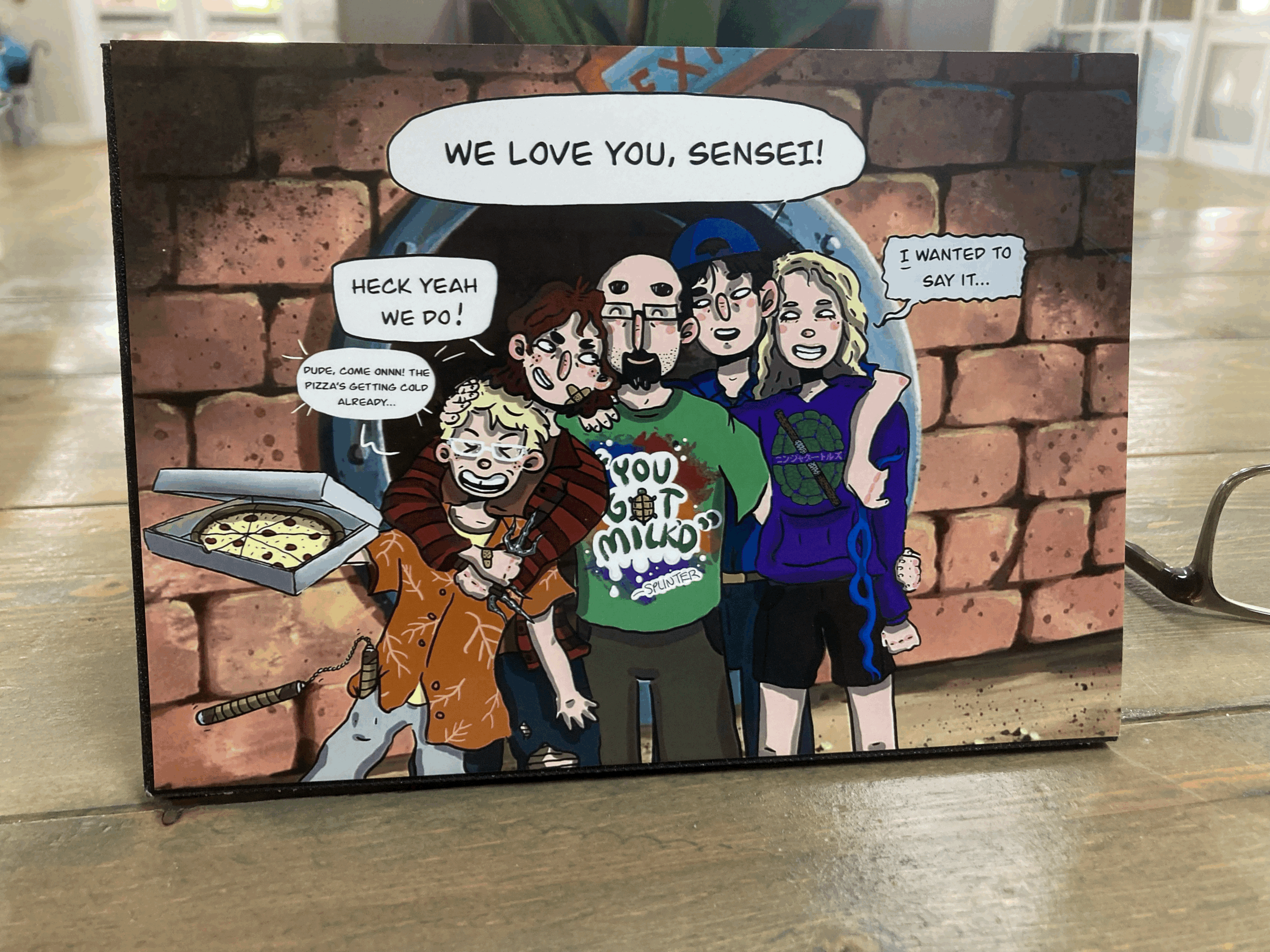
When you look at our social media, you can see a “6” attached to our email and handles. Why the “6”? Because I am a husband and a dad. there are six of us. And all six of us make Argo Art work. We are all “creatives.” Every member of our family inspires the artwork I put out, as well as creates their own, in some way, either through music, story, acting, craft, design, or speech. You name it. There’s beauty all around this business and it comes out of six people, not just one (and not to mention a beautiful community of friends and family in which we find ourselves placed). I say all that to give a shout out to my oldest daughter, the amazing artist who gave me this digital artwork (pictured with this post) for the last Father’s Day. She drew me and our four children as Teenage Mutant Ninja Turtle cartoon characters. It was one of the coolest gifts I’ve ever been given.
I plan to write a bit more about this concept of “art that tells a story” from my experience with the Jazz Art Writers South (JAWS) festival last year. However, let me reiterate by saying that, with what I create, I am not just an individual telling his own personal story. My artwork is part of the story of me, my immediate family, my extended family, my faith, my ancestors, my place on earth. Then my own story connects with the stories of many others who commission and collect artwork that tells or connects with their stories. It’s a profound responsibility and privilege. May God help me steward it well and tell the stories faithfully.

Art as Hospitality
There have been many other reasons people have chosen to give art to others. Giving artwork to your home as a gift to your every guest is a beautiful reason.
There have been many other reasons people have chosen to give art to others. Giving artwork to your home as a gift to your every guest is a beautiful reason.
A couple came to me asking me if I could do a four-painting set for a home they’d just built. Their interior decorator had suggested that one wall would be best filled with original paintings. They asked if I could do four paintings themed around the Bay Area where they live: a blue crab, a heron, a pelican, and an oyster.
We don't just give art to fill the wall. Art helps us enjoy the life we share with family, friends, and even strangers we welcome into our homes.
Hans Rookmaaker suggests that there is a reason we decorate our homes with paraphernalia on theme with our contexts. For example, people who live in our region decorate their walls with piers, sunsets, boats, fishing scenes, and the beach. Rookmaaker claims that this helps us experience more deeply the reality of the place where we live, and it offers us a way to enjoy these things, to give thanks for them. One additional benefit of this is how, when we purchase and hang art on the wall, when we practice hospitality, we offer people a moment to share our own enjoyment over something. A loving reuniting of the broken human community.
A woman we know well has artwork all over the walls of her home. Many of them depict periods in her family’s life. In the foyer hangs a portrait of her late husband. When I first visited her home, I went around and asked about as many paintings as I saw. She was more than happy to give me the history and the context for each piece, not to mention the fact that she shared how each piece made her feel. I felt valued, trusted, and in return I gave value and trust to her life and home.
Hospitality is becoming a lost art, particularly where subdivisions and privacy fences are taking over. Wouldn’t it be wonderful to be a part of a revolution to bring people into our homes and, whether through art we’ve collected or a meal we enjoy, to share with them the joy we experience and the gratitude we feel at what God has given us? No doubt this would be a powerful counter to the pain and alienation we so often feel, the loneliness and meaninglessness. Art and hospitality give us a powerful balm against these evils.

Toward a Philosophy of Art: Wise Influences
As I’ve said, the foundation for doing what I do comes primarily from the Bible, where God commissions artistic work for the purpose of glorifying Him and displaying His beauty to others. Along my journey, I’ve also come across wise influences to help direct me in my art career so that my work is never purely for money, vain imitation, or people-pleasing. Two primary influences that have been helpful to me are Harlan Hubbard, a Kentucky painter, and Hans Rookmaaker, a Dutch art historian and critic.
As I’ve said, the foundation for doing what I do comes primarily from the Bible, where God commissions artistic work for the purpose of glorifying Him and displaying His beauty to others. Along my journey, I’ve also come across wise influences to help direct me in my art career so that my work is never purely for money, vain imitation, or people-pleasing. Two primary influences that have been helpful to me are Harlan Hubbard, a Kentucky painter, and Hans Rookmaaker, a Dutch art historian and critic.
Harlan Hubbard is one of the most beautiful non-conformists I’ve ever heard of in the history of art. He and his wife, Ann, spent a good deal of their lives on a shanty boat they’d built. Once the US Census screwed up their lifestyles and forced them to settle somewhere (and pay taxes), they built a home, where Halan drew and painted the Kentucky countryside. He wrote, "I do not paint with any idea of expressing my emotions, that would seem to me in bad taste. One should paint to express his joy in what he sees and his thanks for that joy." That statement struck deep in my heart; it resonated with me and put words to what I’d felt my whole life, ever since I fell in love with the landscape work of Albert Bierstadt and the Impressionists. I paint because I am thankful for the joy at the beauty that surrounds me wherever I live.
Harlan Hubbard also wrote, "Painting is an act of love." I agree with that sentiment. And I’ve striven to make every work of art that I do an act of love, if not for the subject or the medium, at least as an act of loving service to my neighbor who has asked me to bring their artistic vision to life.
Likewise, Hans Rookmaaker, who had significant influence on apologist Francis Schaeffer, has taught me a great deal about how to think about art, in general. Art should speak to every part of life. Art depicts a worldview. It is never neutral. He writes, "Art shows our mentality, the way we look at things, how we approach life and reality."
Rookmaaker also had something to say about the ultimate reason a Christian strives to make art. Many artists want to be great, just like athletes or musicians. But the Christian artist serves to glorify his own Creator, the Ultimate Artist. He writes, "In the last resort art is anonymous. Who knows the names of the great sculptors of the Gothic cathedrals? Who knows the names of the architects of even the building that has been made quite recently? Everybody knows that a good performance is never the work of one person alone but that he or she needed the help of many others. The one person was in a way the brand name, the trademark. The paintings, the songs, the good designs of cars and other industrial products are anonymous. It is good that way. We have only added to the world God gave us to develop, to beautify. We have added to the lives of many, loving our neighbors. That should be the greatest achievement."
What a summary: to add beauty to the world God gave us and to add to the lives of others. That would indeed be my greatest achievement, and the greatest achievement of any artist.

Toward a Philosophy of Art: The Foundation
As I’ve said, the foundation for doing what I do comes primarily from the Bible, where God commissions artistic work for the purpose of glorifying Him and displaying His beauty to others. Along my journey, I’ve also come across wise influences to help direct me in my art career so that my work is never purely for money, vain imitation, or people-pleasing. Two primary influences that have been helpful to me are Harlan Hubbard, a Kentucky painter, and Hans Rookmaaker, a Dutch art historian and critic.
For a start, I think it’s important to establish a philosophy of art. In other words, I feel I need to address the question, Why do I do this? What principles guide the way I make art? I am not an abstract expressionist. I am not interested in communicating my own feelings, at least not primarily. I want to draw attention to the beauty that surrounds us, which I believe corresponds to the joy I find in observing it.
Rather than just trying to turn out artwork, along the way I found it helpful to consider what my goals are as I wrestle with each painting or drawing. My first foundation, as with everything else I do, is the Bible, which has surprisingly clear guidance for the arts. In the Old Testament, two artisans, Bezalel and Oholiab, are commissioned to lead teams in the construction of the places and items for worship. God gave them two guiding principles for fashioning art: for glory and for beauty. It was meant to be “for glory” in that the art was meant to point to the majesty and greatness of the Ultimate Artist. But it was also “for beauty” in that it was meant to inspire wonder, thought, reverence, and even enjoyment. I want my own artwork to deepen people’s appreciation of the beauty around them. I also hope this would lead people to wonder at the goodness of the God who made them.